
Pittsburgh Captures the AI Power Stack: 5 Insights from Eos Energy's $352.9M Bet
By: Carlos J. Queirós
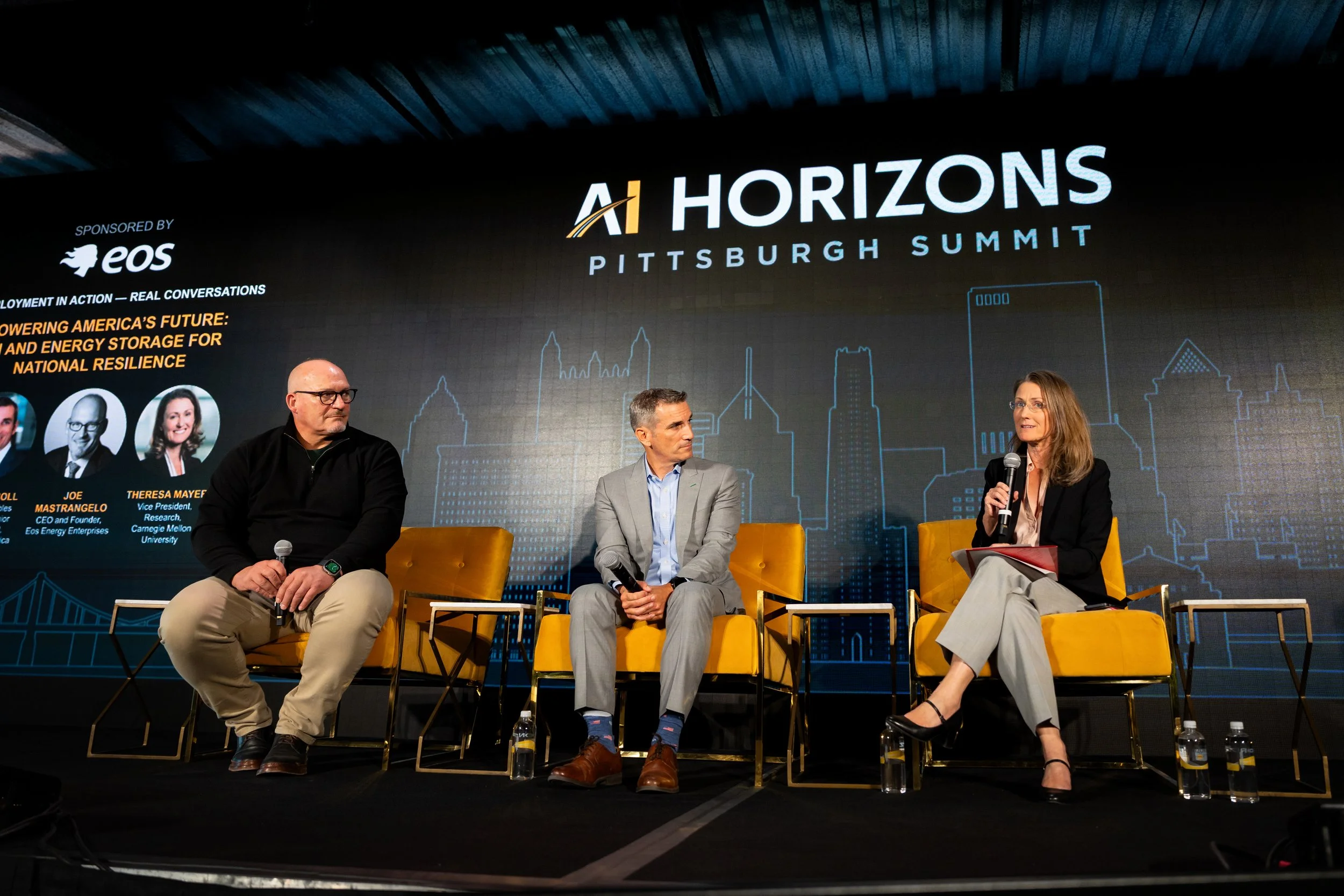
At AI Horizons 2025 (from left to right): Joe Mastrangelo, CEO and Founder of Eos Energy Enterprises; Dave Carroll, Chief Renewables Officer and Senior Vice President of Engie North America; Theresa Mayer, Vice President, Research at Carnegie Mellon University
Six years ago, Eos Energy CEO Joe Mastrangelo made a straightforward business decision about Pittsburgh.
"We came here just because it was cheap," he admitted at the recent AI Horizons 2025 conference.
Then came the pivot: "We'll stay here because there's great people that can help us develop the software."
Now, Eos is moving its global headquarters from New Jersey to Pittsburgh and bringing $352.9 million in investment and 1,000 jobs with it.
🔋 The company manufactures long-duration batteries (4-16+ hours) that solve data centers' biggest headache: reliable power without Chinese supply chain risk.
📖 We drew from Mastrangelo's panel participation at AI Horizons 2025, state economic development announcements, and technical specifications to understand why Pittsburgh won this deal and what it means for the region's AI infrastructure buildout.
Below are five insights about Project AMAZE and Pittsburgh's emerging position in the AI economy.
1. 🏭 From Cheap Space to Tech Hub
In 2019, Eos Energy built a battery manufacturing operation in a former Westinghouse facility in Turtle Creek. Standard manufacturing play of legacy industrial space at bargain prices.
But Project AMAZE is different.
Founded in 2008, Eos has spent nearly two decades developing its zinc-based battery technology. Now the company is building three integrated facilities:
40,000 sq ft corporate HQ at Nova Place
432,000 sq ft automated manufacturing in Marshall Township
Existing operations in Turtle Creek
"This isn't just battery manufacturing," says Joanna Doven, executive director of Pittsburgh’s AI Strike Team. "It's the intelligence layer that hyperscalers need for reliable power and redundancy."
The Nova Place headquarters opens late 2026. Teams there will develop DawnOS™ — EOS's proprietary AI-powered battery management system.
Eos joins a cluster of advanced manufacturing, data center, AI, electric utilities, and robotics companies already at Nova Place.
Carnegie Mellon sits minutes away. That proximity matters. The university is formally deepening its partnership with Eos to develop the workforce for the software hub.
The Marshall Township facility marks a manufacturing evolution — transitioning from single-piece flow operations to high-efficiency, large-scale production lines. Years of process development coming to fruition.
📊 The Big Picture: Combined production target of 8 gigawatt-hours annually — batteries purpose-built for AI workloads lasting 4-16+ hours. That's the "long-duration" sweet spot data centers need for backup power and grid stabilization.
2. ⚡ Solving the "Bursty Power" Problem
Data centers running AI workloads don't need steady power. They need responsive power.
The International Energy Agency projects global electricity consumption from data centers and AI will more than double by 2030, with the United States driving the largest share of growth.
Here's what keeps data center operators up at night: AI workloads create "bursty" power demand. Electricity consumption swings wildly—like a heart monitor gone haywire — dozens of times per hour.
Traditional grids weren't built for this. They're designed for your refrigerator's steady hum, not AI's unpredictable surges.
When an AI training run suddenly demands 10 megawatts, then drops to 2 megawatts minutes later, Eos systems absorb the shock.
Why hyperscalers care:
🔥 Safety: Non-flammable zinc chemistry (Znyth™) uses water-based electrolyte. No thermal runaway = no catastrophic fires. Result? ~30% lower capex because you skip expensive fire suppression systems.
💰 Cost clarity: 20-year lifespan with no degradation surprises. Lithium-ion competitors need costly "augmentation" (essentially battery replacement) at year 10. For 20-year data center operations, that's predictable costs versus massive unplanned expenses.
🌍 Environmental compliance: 84% lower greenhouse gas footprint, 71% lower water use. Critical when tech companies face sustainability commitments and data centers compete with communities for water access in drought-prone regions.
📊 Market Validation: Talen Energy is deploying Eos systems across Pennsylvania's AI infrastructure. MN8 Energy signed supply agreements targeting enterprise and data center deployments. These aren't letters of intent, they're purchase orders.
3. 🇺🇸 Breaking the Chinese Supply Chain Chokepoint
China controls ~90% of global rare earth processing. The country has weaponized this repeatedly through export controls and licensing requirements targeting Western supply chains.
The U.S. imports roughly 70% of its rare earth supply from China. That's a critical vulnerability affecting defense systems (F-35 fighters, submarines, advanced radar), critical infrastructure, and — yes — lithium-ion batteries that power most data centers today.
Eos bypasses it entirely with 91% domestic content, zero rare earths.
Mastrangelo's design philosophy was pragmatic from day one:
"You could put anything you want in the battery as long as it already exists and it's got its own supply chain. No supplier in the world is going to build a special product for a startup company."
The result: zinc-based chemistry using earth-abundant materials. Primary material (zinc) is a U.S.-designated critical mineral with domestic mining operations. Complete bypass of the Chinese chokepoint.
Translation for hyperscalers: If you're building in Pennsylvania, your battery storage is manufactured locally. No transcontinental shipping delays. No supply chain complexity. Your backup power arrives from Marshall Township, not Shenzhen.
📡 On Our Radar: The U.S. Department of Energy issued a conditional loan commitment to Eos, federal backing that Allegheny County Executive Sara Innamorato called "critical support" in making the expansion possible. The message is clear: non-lithium-ion battery tech is a strategic priority. The goal: reshore critical technology manufacturing and reduce dependence on adversarial supply chains.
“I’m not sure our company would have gotten to this point if we weren’t in a gritty city where you could take a punch and keep going.”
4. 💰 How Pennsylvania Competed — and Won
Pennsylvania built a $24M incentive package:
$10M Pennsylvania First grant (state flagship job creation program)
$12M Redevelopment Assistance Capital Program
$2M Allegheny County Economic Redevelopment Authority
Additional eligibility for Manufacturing Tax Credits, R&D Tax Credits
But the incentive package tells only part of the story.
The Shapiro approach: "Cutting red tape, building out our skilled workforce, and investing in the next generation of energy technology," as Governor Shapiro described it. The BusinessPA team operates with a mandate to "move at the speed of business"—fast permitting, streamlined approvals, proactive partnership rather than reactive negotiations.
"The demand for energy is going up — and my Administration is capitalizing on Pennsylvania's strengths," Governor Shapiro stated. "We're doubling down on our efforts to aggressively compete for — and win — major projects like this one."
The numbers back the strategy. Nearly $26 billion in private sector investment attracted since taking office.
At AI Horizons, Mastrangelo praised Pennsylvania's unified approach with Governor Shapiro and Senator McCormick demonstrating bipartisan support:
"The competition is not against ourselves. It makes me proud to be in the Commonwealth and building our company here because you have the support of both the Republican and the Democratic side to build great companies and allow the country to win this AI race."
Policy stability matters when you're deploying hundreds of millions in capital.
📊 The Results: The July 2024 AI & Energy Innovation Summit at Carnegie Mellon, co-hosted by Senator McCormick and Governor Shapiro, generated over $90 billion in investment announcements. Bipartisan alignment creates the policy stability long-term capital deployment requires.
5. 🏙️ Pittsburgh's Grit Factor
What made Pittsburgh different from other potential sites?
Mastrangelo's answer at AI Horizons focused on culture, not incentives:
"I'm not sure our company would have gotten to this point if we weren't in a gritty city where you could take a punch and keep going."
Manufacturing resilience requires workforce resilience. The kind that iterates through startup-phase challenges without folding.
What Pittsburgh delivered:
Skilled trades for complex hardware manufacturing
Elite software engineering talent from CMU
Manufacturing capacity without megafactory requirements
Existing industrial infrastructure (that Westinghouse facility matters)
A workforce that understands how to build things
Union manufacturing jobs through continued partnership with the United Steelworkers
"In Pittsburgh you can not only build products in America but also offer world class education and intellectual capabilities to grow emerging industries," said Pranesh Rao, Eos Senior Vice President of Storage System Engineering.
The symbolic continuity is deliberate. Eos operates from a former Westinghouse facility in Turtle Creek. Westinghouse innovations electrified 20th-century America. Now Eos manufactures batteries to power the AI revolution from that same industrial heritage.
Stefani Pashman, CEO of the Allegheny Conference on Community Development, emphasized the labor commitment: "We're especially proud that this growth comes with a continued commitment to the company's partnerships with local universities and the United Steelworkers — ensuring that good, family-sustaining jobs remain at the center of this story."
📡 On Our Radar: With the Nova Place headquarters opening late 2026, Pittsburgh is demonstrating how industrial cities can successfully merge hardware manufacturing with software innovation at scale, providing a blueprint other regions are watching closely.
⚡The Pittsburgh Power Play⚡
Project AMAZE represents a critical layer of AI infrastructure that often gets overlooked: the energy storage and management systems that make hyperscale operations viable.
Data centers need 99.99% uptime. No room for error. No dependence on adversarial supply chains.
Pennsylvania offers what few regions can match:
Abundant energy generation
Advanced battery manufacturing at scale
Elite university talent (CMU with formal partnerships)
Bipartisan political support that creates policy stability
Speed and simplicity in permitting
All in one place
Pittsburgh is also proving it can attract corporate headquarters, not just manufacturing.
Companies building AI infrastructure should pay attention. The complete stack is being built here — from power generation to intelligent storage to software optimization.
As Mastrangelo put it: "We're here talking about energy for AI, but we need AI for energy."
The DawnOS platform uses AI to optimize charge and discharge cycles across thousands of battery cells simultaneously. Work that required days of data scientist analysis now happens in real-time.
That's the symbiosis Pittsburgh is betting on.
Governor Shapiro connected the dots explicitly: Eos batteries will "help power some of the data centers being built across the commonwealth."
Translation: if you're building data center infrastructure in Pennsylvania, your locally-manufactured energy storage eliminates supply chain complexity and accelerates deployment timelines.
📊 Markets to Watch: Pennsylvania's integrated AI infrastructure ecosystem now includes power generation, battery manufacturing, software development, and hyperscale data center deployments — positioning the region as a complete vertical stack for AI infrastructure development. The question isn't whether Pittsburgh can compete. It's whether other regions can replicate this integrated model.
🎯 Watch Eos Energy CEO Joe Mastrangelo at AI Horizons 2025
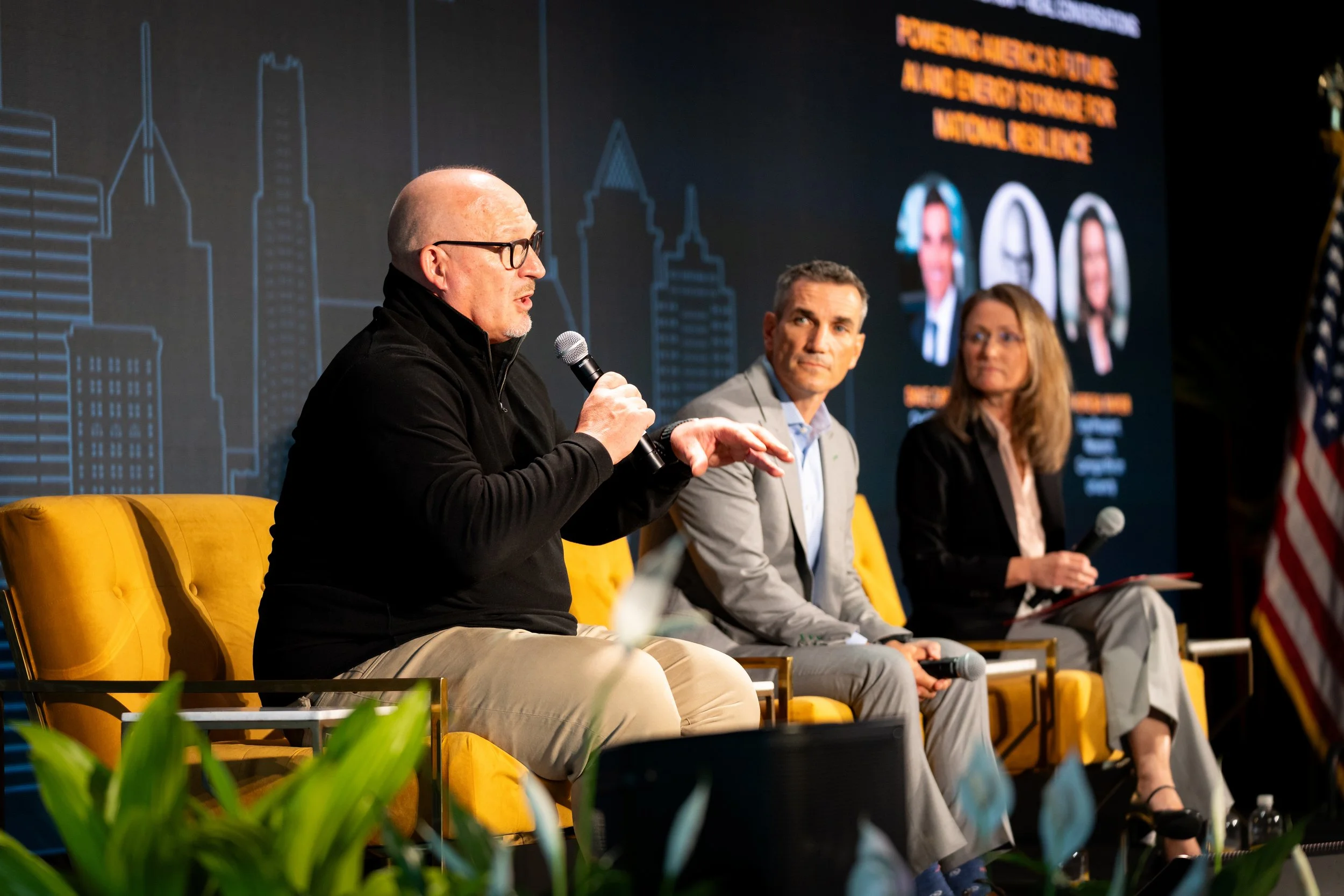
Mastrangelo Key Quotes
On why Pittsburgh won:
"We came here six years ago just because it was cheap... we'll stay here because there's great people that can help us develop the software."
On manufacturing resilience:
"I'm not sure our company would have gotten to this point if we weren't in a gritty city where you could take a punch and keep going."
On the AI-energy symbiosis:
"We're here talking about energy for AI, but we need AI for energy." The DawnOS platform uses artificial intelligence to optimize charge and discharge cycles across thousands of battery cells simultaneously. Work that previously required days of data scientist analysis now happens in real-time.
On bipartisan support:
"The competition is not against ourselves. It makes me proud to be in the Commonwealth and building our company here because you have the support of both the Republican and the Democratic side to build great companies and allow the country to win this AI race."
On building in America:
"You could put anything you want in the battery as long as it already exists and it's got its own supply chain. No supplier in the world is going to build a special product for a startup company." This constraint led to earth-abundant materials and scalable domestic manufacturing.
On market timing:
The energy storage market is only five to six years old — "early days." But customer demand has accelerated to gigawatt-scale requirements, driving Eos's expansion beyond a single production line to meet the AI infrastructure buildout.
On Pennsylvania's ecosystem:
"In today's competitive environment, and in what we're working to achieve in powering the nation's future, you need not only natural resources and technology innovations, but also a strong public-private partnership. What we are announcing today is built upon a strong industrial history, combined with a world class university ecosystem. Pennsylvania is positioning itself at the forefront of America's energy transition — enabling us to bring America's battery to scale."
